Chain Type Analysis: How Engineers Choose the Right Conveyor Chain
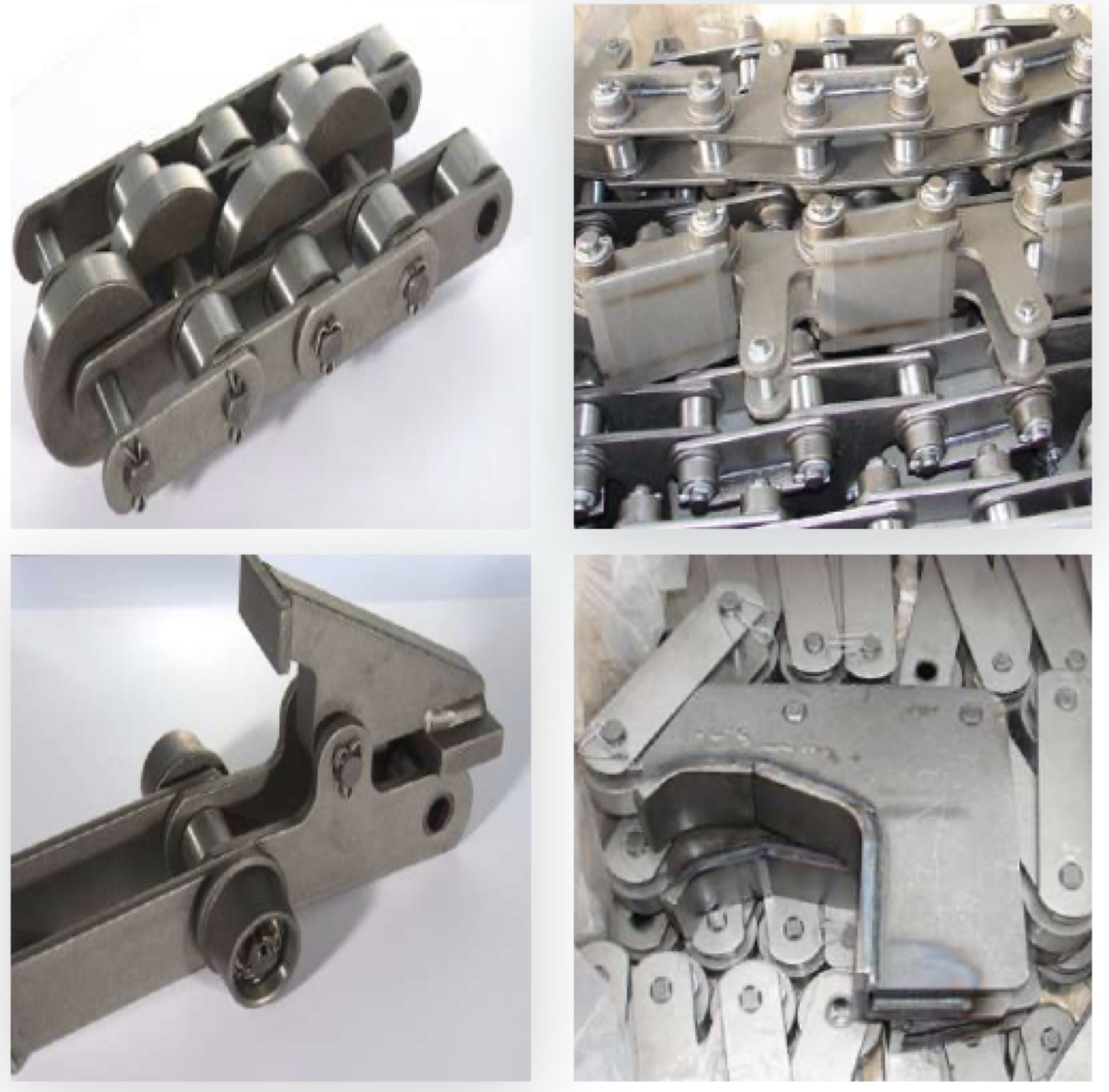
Many chains wear out early or break not because of poor quality, but because the chain type does not suit the operating conditions. Choosing conveyor chain is not just matching a catalogue number — it is an engineering analysis: understanding the material, load, conveyor geometry and environment, then turning that into a chain specification. This article walks through the steps the VOLER engineering team uses when analysing and selecting chain for your plant.
1. Know the Conveyor Chain Types
The first step is to understand the main chain families and what each is designed for:
| Chain type | Key characteristics | Typical applications |
|---|---|---|
| Forged link chain (rivetless / drop forged) | Forged links, very high tensile strength, abrasion resistant | Drag chain conveyors, scrapers, feeder breakers |
| Bush / roller conveyor chain | Pins, bushes and rollers between side plates; low friction, wide choice of attachments | Bucket elevators, apron feeders, slat conveyors |
| Welded steel / mill chain | Rugged welded construction, tolerant of dirty and wet conditions | Sugar mill cane carriers & bagasse, timber, pulp & paper |
| Round link chain (high tensile) | Alloy steel round links, flexible in every direction | Mining armored face conveyors, cement bucket elevators |
| Custom / engineered chain | Designed to a drawing or sample (reverse engineering) | Older machines, discontinued OEM chain, special requirements |
2. Collect the Operating Data
An accurate analysis starts with complete data. Before choosing the chain type and size, gather the following:
- Material: type, bulk density (t/m³), lump size, abrasiveness, temperature, moisture and corrosiveness.
- Capacity & speed: required tonnes per hour and chain speed (m/s).
- Conveyor geometry: length (sprocket centre distance), incline or lift height, and layout.
- Duty: operating hours per day, start-stop frequency, impact loads from dumping.
- Existing components: sprocket tooth count and diameter, attachment or flight type, and drawings if available.
- Failure history: service life of the previous chain and how it failed (see section 6).
3. Calculate Chain Pull & Safety Factor
The core of chain selection is making sure the chain's breaking load is well above the maximum operating pull. For a horizontal drag chain conveyor, a first estimate of chain pull can be made with a simple formula:
T = chain pull (N) · g = 9.81 m/s² · L = conveyor length (m)
qm = material weight per metre = Q ÷ (3.6 × v) (kg/m), with Q in t/h and v in m/s
qc = chain + flight weight per metre (kg/m) · μm, μc = friction coefficients of material and chain
Example: coal drag conveyor, 300 t/h capacity, 0.3 m/s speed, 40 m long, chain + flights 60 kg/m, μm = 0.5 and μc = 0.3.
- qm = 300 ÷ (3.6 × 0.3) ≈ 278 kg/m
- T = 9.81 × 40 × (278 × 0.5 + 2 × 60 × 0.3) ≈ 68,600 N ≈ 69 kN
- With a 1.3 service factor for start-up and impact: design pull ≈ 89 kN
- With a safety factor of 8 and two chain strands sharing the load unevenly (60:40): minimum breaking load per strand ≈ 0.6 × 89 × 8 ≈ 430 kN
Safety factors for heavy-duty industrial conveyor chain typically range from 7 to 10 against breaking load. Higher values are used for severe impact duty such as feeder breakers and apron feeders. The formula above is a simplification for a first estimate — inclined conveyors, bucket elevators and special materials are calculated differently, and friction coefficients must match the actual material.
4. Choose the Pitch & Sprockets
Chain pitch affects strength, weight and smoothness of motion:
- Larger pitch — stronger with fewer joints, but more pulsating motion (polygon effect) and larger sprockets.
- Sprocket tooth count — at least 8 teeth, ideally 10–12 or more, to reduce the polygon effect, wear and vibration.
- Replacing an existing chain — pitch and profile must match the existing sprockets. Worn sprockets should be replaced together with the chain.
5. Select Material & Heat Treatment
Once the size is set, material and heat treatment decide the service life:
- Abrasive materials (clinker, sand, coal mixed with rock) — alloy steel with carburizing or case hardening: a hard, wear-resistant surface over a tough core that absorbs impact.
- High impact loads — prioritise core toughness, not just surface hardness. A chain that is too hard becomes brittle and cracks easily.
- Hot materials (clinker, ash) — choose material and tempering that stay stable at operating temperature, with clearances that allow for thermal expansion.
- Wet / corrosive environments (sugar, fertilizer, pulp) — consider corrosion-resistant material, coatings or larger pin-bush clearances.
Every VOLER chain comes with a raw material certificate and passes dimensional, hardness and breaking-load tests against the drawing.
6. Analyse the Old Chain: Read the Failure Pattern
A failed chain is the best source of data. Its failure pattern shows what needs to improve in the next chain specification:
| Symptom | Likely cause | Direction of solution |
|---|---|---|
| Rapid elongation (pitch stretch) | Pin & bush wear from abrasion or poor lubrication | Harder surfaces, deeper case depth, better lubrication or sealing |
| Cracked or broken links | Overload, impact or fatigue | Higher breaking load, tougher material, find the source of impact |
| One-sided side plate wear | Sprocket or chain path misalignment | Correct alignment, check guides and sprockets |
| Bent flights | Impact from large lumps or jammed material | Thicker or reinforced flights, check inlet and hopper |
| Heavy corrosion or pitting | Wet or chemical environment | Corrosion-resistant material, coatings, routine cleaning |
If the old chain is no longer produced, its physical sample can be the basis for reverse engineering — and an opportunity to upgrade the specification based on the failure analysis.
Conclusion
The right chain is chosen by analysis, not guesswork: know the chain types, collect the operating data, calculate pull and safety factor, match pitch and sprockets, select the right material, and learn from previous failures. The result is longer service life, less downtime and a lower cost per tonne. Send your operating data, drawings or photos of your old chain to the VOLER engineering team — we will analyse them and recommend the most suitable chain, free and with no obligation.
Custom Conveyor Chain & Material Handling · Free Consultation · WhatsApp